Home > CBSE vs IB: What Parents Should Consider Before Choosing a School
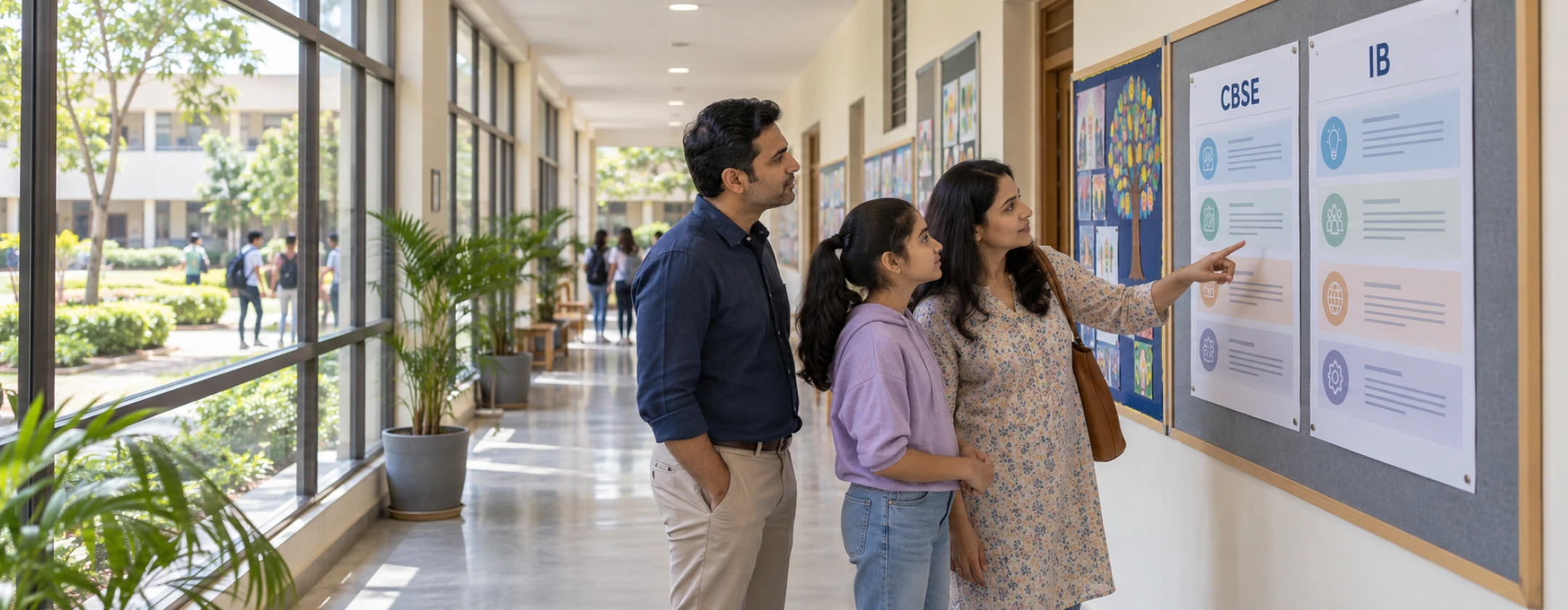
Choosing between CBSE and IB is not simply a question of which board is more modern, more rigorous, or better known. The more useful question is whether the curriculum, teaching approach, assessment pattern, and day-to-day learning environment are suitable for your child and your family’s plans.
There is also an important distinction that is often missed in CBSE vs IB comparisons: CBSE is a national-level school education board in India, while the International Baccalaureate (IB) offers four different educational programmes for students from ages 3 to 19.
That means the relevant comparison changes with your child’s age. A parent of a Grade 4 student, for example, would generally be comparing a CBSE curriculum with the IB Primary Years Programme (PYP), not with the IB Diploma Programme (DP).
So instead of asking only, “CBSE or IB, which is better?”, it is worth asking four more useful questions:
This guide explains the differences so you can make that comparison more meaningfully.
The Central Board of Secondary Education (CBSE) is a national-level board of education under the Department of School Education and Literacy, Ministry of Education, Government of India. It provides curriculum, assessment, and examination frameworks for affiliated schools, including the secondary and senior secondary stages.
| CBSE school stage | Typical age range | School stage |
|---|---|---|
| Foundational Stage | 3–7 | Nursery to Grade 2 |
| Preparatory Stage | 8–11 | Grades 3–5 |
| Middle Stage | 11–14 | Grades 6–8 |
| Secondary Stage | 14–16 | Grades 9–10 |
| Senior Secondary Stage | 16–18 | Grades 11–12 |
CBSE schools operate within the curriculum and assessment requirements prescribed by the board, while individual schools determine how that curriculum is taught in their classrooms.
The current CBSE curriculum includes subject-specific learning objectives, assessment requirements, and opportunities for competency development. Its curriculum documents also explicitly emphasize holistic development, hands-on experience, competency-based learning, and moving away from rote learning.
Go through this comprehensive guide to the best CBSE schools in Hyderabad and learn how to choose the right CBSE school for your child.
The International Baccalaureate is an international education organization offering four programmes
| IB programme | Typical age range | School stage |
|---|---|---|
| Primary Years Programme (PYP) | 3–12 | Primary |
| Middle Years Programme (MYP) | 11–16 | Middle years |
| Diploma Programme (DP) | 16–19 | Senior secondary |
| Career-related Programme (CP) | 16–19 | Senior secondary |
Schools must be authorized to offer IB programmes and become IB World Schools.
This distinction matters when researching CBSE vs IB curriculum.
For a younger child, the comparison may be CBSE vs PYP. For a middle-school student, it may be CBSE vs MYP. For a student entering the final two years of school, the comparison may involve CBSE senior secondary education and the IB Diploma Programme.
The two should not be treated as a single, identical system called “IB.”
Source: International Baccalaureate – programmes.
The broad differences are useful as a starting point, but they should not be treated as a prediction of what every child will experience. School implementation can change the classroom experience considerably.
| Area | CBSE | IB |
|---|---|---|
| What it is | A national school education board in India | An international education organization offering four programmes |
| Curriculum structure | Curriculum and subject requirements are prescribed within the CBSE framework | Structure varies by programme; PYP, MYP, DP and CP have different frameworks |
| Learning approach | Can include direct teaching, conceptual learning, application, activities, projects and competency-based learning | Strong emphasis on inquiry, conceptual understanding, connections and student agency, depending on programme |
| Assessment | Includes school-based assessment and formal examinations at relevant stages | Varies by programme and can include examinations, coursework, projects, investigations, oral work and other assessment tasks |
| Subject structure | Becomes more defined as students progress through secondary and senior secondary education | Varies by programme; the DP has six subject groups plus its core |
| Independent work | Depends significantly on grade, subject and school | Can become particularly significant in programmes such as the MYP and DP |
| International continuity | Widely used in India and also available through affiliated schools outside India | Designed as an international educational framework offered by authorized IB World Schools |
| School implementation | Important | Equally important |
The important point is that neither column tells you everything about a particular school.
A CBSE school can have highly interactive, application-oriented classrooms. An IB school can also have structured teaching, formal assessment and examinations. The programme or board creates a framework; teachers and schools determine much of what that framework looks like in practice.
Source: IB Diploma Programme curriculum
One of the most useful ways to understand the difference between CBSE and IB is to move away from labels and look at what your child is actually expected to do.
CBSE provides a structured curriculum with defined subjects and requirements that become increasingly important as students move through secondary and senior secondary education. The current 2026–27 CBSE curriculum, for example, specifies subject structures and assessment arrangements for the secondary level.
IB curriculum structure depends on the programme.
The MYP, for example, is organized around eight subject groups and requires interdisciplinary learning as part of the programme.
The DP has six subject groups supported by a core consisting of Theory of Knowledge, the Extended Essay, and Creativity, Activity, Service.
So when comparing CBSE vs IB curriculum, look beyond the number of subjects. Ask how those subjects are organized, how much choice students have, and what the student is expected to produce, understand, and apply.
This is where one of the most common CBSE vs IB stereotypes becomes misleading.
CBSE does not automatically mean rote learning, and IB does not mean learning without structure.
CBSE’s own curriculum and teacher guidance explicitly call for moving away from rote methods, encouraging hands-on learning, competency development, and connections between classroom knowledge and life outside school.
IB programmes, meanwhile, place strong emphasis on inquiry, conceptual understanding, connections across learning and student agency, but they also have defined curriculum structures and assessment requirements.
In a well-run classroom, the distinction is therefore more nuanced.
A CBSE classroom might include explicit concept teaching followed by discussion, experimentation, guided practice, application and assessment.
An IB classroom might place greater emphasis on inquiry, interdisciplinary connections, conceptual questions and independent exploration, while still requiring students to build subject knowledge and meet defined academic requirements.
The important question is not which label sounds more progressive. It is whether the teaching approach helps your child understand concepts, ask questions, practise skills, receive feedback, and gradually become more independent.
Assessment is another area where broad comparisons can become misleading.
CBSE uses a combination of school-based assessment and formal examinations depending on the class and subject. Its current curriculum includes subject-specific assessment requirements, while initiatives such as SAFAL are designed around concepts, application of knowledge, and higher-order thinking rather than simple recall.
There is no single “IB assessment system” across all four programmes.
The PYP does not use formal assessment in the same sense as the DP; assessment in the PYP is intended to support learning and provide feedback. The MYP, DP and CP have summative assessment structures that can include examinations, essays, oral interviews, investigations, fieldwork and performances.
The IB Diploma Programme, in particular, includes both internal and external assessment, and written examinations form the basis of assessment for most DP courses.
That means the idea that “IB has no exams” is incorrect.
Likewise, the idea that “CBSE is only about memorizing for exams” does not accurately describe the curriculum framework CBSE currently sets out.
For parents, a more useful question is:
How will my child be assessed throughout the year, and how much of their progress depends on examinations, projects, coursework, classroom performance, and independent work?
Ask the school to show you examples rather than relying on a general description.
Parents often ask whether CBSE or IB has more homework. That question is understandable, but it is too narrow to tell you much.
Academic workload has several dimensions:
A student may have fewer worksheets but spend considerably more time researching, writing, preparing presentations, or completing long-term projects. Another student may have a more structured routine with regular practice and examinations.
The right comparison is therefore not simply “Which board has less homework?”
It is “What kind of academic work will my child be expected to manage, and is that level of independence appropriate for their age?”
No. Choosing IB is not a prerequisite for studying at an international university.
Students from different school systems can apply to universities in India and overseas, subject to the requirements of the particular institution and course.
What matters can include the student’s academic record, subjects studied, grades or scores, language requirements, entrance tests where applicable, and other university-specific requirements.
The better question is:
Which curriculum and subject pathway will allow my child to build the academic preparation required for the courses and universities they may eventually consider?
If your child is likely to apply internationally, speak to the school about how it supports university research, subject selection, documentation, and application planning.
If your family expects to remain primarily within the Indian education system, also examine how naturally the school’s curriculum connects with the subjects, assessments, and pathways your child is likely to encounter later.
University planning should therefore be part of the discussion, but it should not be reduced to the assumption that “IB means foreign university” or “CBSE means Indian university.”
This is especially important for families who may relocate.
A curriculum change can involve more than simply changing textbooks. Your child may encounter differences in:
The point at which the transition happens also matters.
A child moving during primary school may face a different adjustment from a student changing systems shortly before board-level or senior-secondary assessments.
If you are considering a move from CBSE to IB or IB to CBSE, ask the receiving school exactly how it assesses the child’s current level, maps previous learning, and supports the transition.
Even within IB, subject availability can vary between schools, and the IB itself advises families considering transfers to contact the school directly because individual IB World Schools have their own admissions policies and subject offerings.
This is perhaps the most important part of any CBSE vs IB comparison.
The board or programme name does not, by itself, tell you:
Two schools following the same board can provide very different experiences.
That is why visiting a school, speaking to teachers, reviewing examples of student work and asking specific questions can tell you more than the board name alone.
You are not choosing a board in isolation. You are choosing a school that implements that board or programme.
Instead of trying to find a universal answer to “CBSE or IB which is better?”, consider these six questions.
Think about whether your family expects to remain in India, relocate internationally, or keep several pathways open.
Consider how your child responds to structured instruction, discussion, experimentation, independent research, projects, and regular assessment. Avoid reducing this to a simple “learning style” label; children usually benefit from a mixture of approaches.
Some children enjoy managing longer assignments and open-ended tasks. Others initially benefit from more structure and gradually need greater independence as they mature.
Do not compare boards only at a broad level. Look at the actual subjects available in the grades your child will enter and the pathways offered later.
This can be the deciding practical factor. Ask to see lesson plans, student work, assessment examples, or other evidence of how the curriculum becomes classroom practice.
Ask what a normal school week looks like, how teachers provide feedback, how much homework students receive, how assessments are scheduled, and how the school supports children who are struggling or ready for greater challenge.
These questions turn a broad board comparison into a school comparison that you can actually use.
When you visit or speak with a school, consider asking:
Do not be satisfied with broad statements such as “we focus on holistic education” or “we encourage inquiry.”
Ask the school to show you what that looks like in an actual classroom.
That is where the difference between a school’s stated philosophy and its everyday practice becomes visible.
A board provides a framework. A school turns that framework into a student’s everyday experience.
This is why two schools following the same curriculum can feel very different to students and parents.
When comparing schools, look for the connection between four things:
Claim → Practice → Student Experience → Evidence
For example, if a school says it develops independent thinking, ask what teachers actually do to encourage students to reason independently. Look at the kinds of questions students are asked, the work they produce, and the feedback they receive.
If a school says it uses experiential learning, ask what students actually investigate, build, test, discuss, or apply.
If a school says assessment is competency-based, ask how assessment results are used to identify gaps and improve learning.
This approach is useful whether you are comparing CBSE schools, IB World Schools, or schools following another curriculum.
Tatva Global School is a CBSE-affiliated K–12 school in Hyderabad, with CBSE affiliation number 130451.
Tatva describes its educational approach around developing Cognition, Curiosity, Compassion and Character, with Contribution as an outcome. Its stated positioning is centred on education that goes beyond preparation for a career, with an emphasis on developing children who can learn, think, contribute and participate responsibly in the world around them.
For a parent comparing CBSE vs IB, the useful question is not whether Tatva’s CBSE affiliation automatically makes it the right choice.
It is whether Tatva’s interpretation of the CBSE framework matches what you want for your child.
Parents considering the school can therefore explore our curriculum and teaching approach in more detail, ask how those ideas appear in classroom practice, and visit the campus to understand the student experience for themselves.
For families currently considering admissions for 2027–2028, you can explore Tatva’s curriculum to understand its approach and the academic stage pages; for more details, speak with the admissions team about the grade your child is entering.
There is no single answer that applies to every child. The relevant comparison depends on the child's age, the specific IB programme being considered, future education plans, preferred learning environment, subject interests, and the quality of implementation at the school.
CBSE is a national school education board in India, while IB offers four international education programmes: PYP, MYP, DP and CP. The practical difference therefore depends on which CBSE stage and which IB programme you are comparing.
It is difficult to make a meaningful general comparison because academic demands vary by grade, programme, subject and school. The IB Diploma Programme, for example, combines six subject groups with a core that includes Theory of Knowledge, the Extended Essay and Creativity, Activity, Service.
Rather than asking which is harder, ask what kind of academic work your child will be expected to manage.
No. CBSE's curriculum documents explicitly emphasize moving away from rote learning, hands-on experience, competency-based learning, and the application of knowledge.
The actual classroom experience still depends on how a particular school and teacher implement the curriculum.
Yes. Assessment differs across IB programmes. The PYP does not have formal assessment in the same sense as the DP, while the MYP, DP, and CP have summative assessment. In the DP, written examinations form the basis of assessment for most courses.
No. Students from CBSE and other recognized school systems can apply to universities internationally. Requirements vary by university and course, so families should check the specific academic, subject, language, and testing requirements of the institutions they are considering.
It depends on your child's age. The PYP is designed for ages 3–12, the MYP for ages 11–16, and the DP and CP for ages 16–19.
A Grade 4 parent, for example, should not use the IB Diploma Programme as the primary comparison point.
Yes, but the ease of transition depends on the grade, subjects, curriculum sequencing, assessment approach, and the receiving school's admission and placement process. Families should discuss the transition directly with the school before making a decision.
The board name is only the beginning of the decision.
A more useful comparison is:
What will my child learn?
How will my child learn it?
How will my child be assessed?
How much independence will my child need?
What pathways will remain open later?
And how well does the school turn its stated educational approach into everyday classroom practice?
Once you ask those questions, CBSE vs IB becomes less about choosing between two labels and more about understanding the education your child will actually experience.
Still deciding between CBSE and IB for your child? The best way to understand what a school offers is to experience it firsthand. Visit the Tatva Global School campus to understand how its CBSE approach is implemented in practice. See how learning happens beyond the classroom, and speak with the school team about your child’s needs.
Admissions for 2026–27 are open.
We’ll hold the door.