Home > School Facilities Checklist: What Parents Should Look for Before Admission
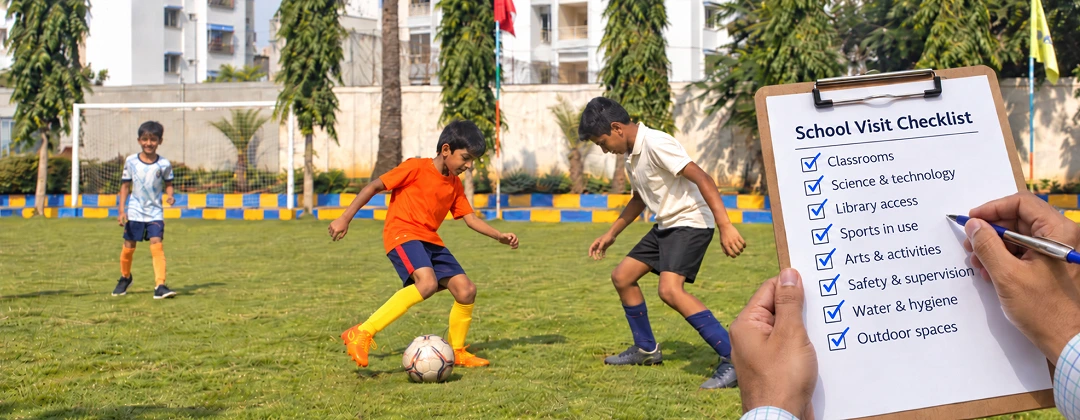
A school may have a large campus, impressive buildings, and a long list of facilities. But there is one important question parents should ask before choosing a school:
When comparing schools, it is easy to focus on what looks impressive: smart classrooms, science laboratories, libraries, sports facilities, technology, and campus size.
But infrastructure matters most when it supports students’ everyday learning, development, safety, and wellbeing.
A science laboratory is valuable when students get opportunities to conduct experiments. A library matters when children can access books regularly. Sports facilities are useful when students have meaningful time to participate. Classrooms should provide a comfortable environment where children can learn, ask questions, and collaborate.
This school facilities checklist will help you evaluate the infrastructure that matters, understand what to ask during a campus visit, and compare schools before making an admission decision.
A school’s infrastructure should be evaluated on more than its appearance or availability.
Use these six questions when assessing any facility.
| What to check | What parents should understand |
|---|---|
| Availability | Does the facility exist? |
| Suitability | Is it appropriate for your child's age and grade? |
| Access | Can students in your child's grade use it? |
| Usage | How frequently and for what purpose is it used? |
| Condition | Is it clean, safe, functional, and maintained? |
| Student value | How does it contribute to learning or wellbeing? |
Two schools may both have a library or science laboratory but provide very different experiences for their students.
Don’t just count facilities. Evaluate access, use, condition, and value.
School infrastructure requirements and applicable safety standards provide important baseline expectations. However, parents should also understand how facilities are used in everyday school life.
Children spend a substantial part of their school day in classrooms, making these spaces one of the first things to evaluate.
Look beyond modern furniture, projectors, or smart boards. Consider whether the classroom supports comfortable and effective learning.
Check for:
Questions to ask:
A well-equipped classroom is a good starting point, but how teachers and students use that space is what matters most.
Science laboratories and technology spaces can give students opportunities to explore concepts beyond textbooks.
However, the presence of equipment does not automatically mean students use it regularly.
When evaluating laboratories, ask about the facilities available for your child’s grade and how practical learning is incorporated into lessons.
Look for:
Questions to ask:
Remember: Technology installed is not the same as technology used effectively. Ask how these resources help students understand, practise, and apply what they learn.
A library should be more than a room filled with books. It should give students opportunities to read, explore subjects, and develop independent learning habits.
During your visit, consider:
Questions to ask:
A useful library is one that students can access and use meaningfully, not simply one that looks impressive during a campus tour.
Sports and physical activity can support teamwork, coordination, discipline, confidence, and overall wellbeing.
The right facilities will depend on your child’s age, interests, and opportunities to participate.
Look for:
Questions to ask:
A large playground is valuable when students have regular opportunities to use it. Ask about the actual timetable and participation opportunities rather than judging only by its size.
School life also includes opportunities for creativity, expression, and collaboration.
Depending on the school and grade, these activities may include visual arts, music, dance, drama, clubs, projects, and other creative pursuits.
Look for spaces that allow students to practise, create, collaborate, and display or perform their work.
Questions to ask:
Do not evaluate extracurricular opportunities only by the number of activities advertised. Understand what students can realistically participate in during a normal school week.
Safety is one of the most important aspects of a school environment. It involves more than visible equipment and security cameras.
Parents should understand how the school manages access, supervision, emergencies, and student wellbeing.
Check the arrangements for:
Questions to ask:
Applicable CBSE affiliation requirements and school safety rules establish important expectations for school infrastructure and safety. Parents should confirm the school’s current compliance and procedures rather than assuming that visible security features tell the whole story.
The key question is not simply how many cameras or security systems a school has. It is how these systems work alongside supervision, access control, and emergency procedures.
Cleanliness and maintenance affect students every day. These areas can be easy to overlook when a campus tour focuses on impressive buildings and specialist facilities.
Inspect the everyday spaces your child will use.
Look at:
Questions to ask:
A school does not need to look untouched to be well maintained. Look for evidence that frequently used spaces are clean, functional, and cared for consistently.
Children use more than classrooms during the school day. They move through corridors, gather for assemblies, participate in activities, and spend time in shared spaces.
During your visit, look at:
Areas used for recreation and interaction
Safe movement between different parts of the campus
Questions to ask:
A large campus can offer many possibilities, but the most useful question remains: what does your child actually get to do in these spaces?
When visiting a school, turn general claims into specific questions.
| If the school says... | Ask this question |
|---|---|
| “We have modern science laboratories.” | Which grades use them, how often, and what practical work do students do? |
| “We have smart classrooms.” | How is technology used to improve everyday learning? |
| “We offer extensive sports facilities.” | How much regular access does each grade receive? |
| “We have a large library.” | How often can students visit, and can they borrow books? |
| “We have excellent security.” | What systems and procedures support student safety? |
| “We have a large campus.” | Which parts of the campus will my child's grade actually use? |
| “We offer many extracurricular activities.” | Which activities are available to my child's grade, and how frequently? |
This approach is not about challenging the school for the sake of it. It is about understanding what the facilities mean for your child’s everyday experience.
When something is important to your decision, ask for an example or a clear explanation of the school’s usual process.
Use this checklist during your campus visit. Mark each item as Yes, No, or Need to Verify.
| What to evaluate | School A | School B |
|---|---|---|
| Classroom environment | ||
| Science and technology access | ||
| Library usage | ||
| Sports and activity opportunities | ||
| Safety and supervision | ||
| Hygiene and maintenance | ||
| Accessibility | ||
| Regular use of facilities | ||
| Questions still unanswered |
Record what you observed, what the school told you, and what still needs verification. This makes comparisons more consistent and helps prevent one impressive facility from dominating your decision.
Facilities are an important part of the school experience, but they should not be the only factor in your admission decision.
A well-equipped classroom cannot tell you everything about teaching quality. A large library does not automatically establish how often students read. Sports infrastructure alone does not tell you how much time children spend participating.
Evaluate facilities alongside:
The aim is not to find the school with the longest facilities list. It is to understand which school offers an environment that fits your child’s learning needs, interests, and daily life.
When researching schools, online photographs and facilities lists are useful starting points. A campus visit helps you understand the spaces, ask questions, and learn how students use the school’s infrastructure.
If Tatva Global School is on your shortlist, ask about the facilities available to your child’s grade, their regular use, student supervision, academic support, and everyday school routine.
Tatva’s published school information describes an 11-acre campus in Gajularamaram, Hyderabad, serving students across K–12. Please confirm the current campus details, grade offerings, and facilities directly with the school.
Bring this school facilities checklist to your visit, explore the relevant learning spaces, and ask the questions that matter most to your family.
See the campus in person, understand the learning environment, and make a more informed decision about your child’s education.
Admissions for 2026–27 are open.
We’ll hold the door.