Home > CBSE vs ICSE: Which Board Is Right for Your Child?
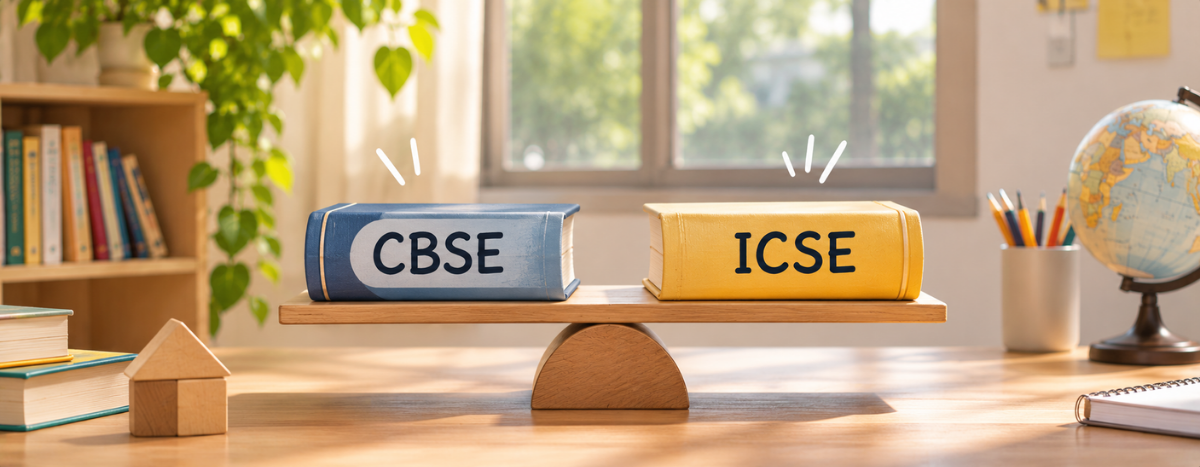
Choosing a school involves more than finding a convenient location or looking at the facilities. One of the most important decisions parents make is choosing an education board. In India, CBSE and ICSE are two widely considered options, and both offer structured academic programmes, recognised qualifications, and opportunities for further education.
But when you compare CBSE vs ICSE, the differences can raise several questions. Is one curriculum more suitable for your child’s learning style? Does either board offer an advantage in competitive examinations? How do their subject choices, assessments, and language requirements differ? And what should parents consider if they may relocate or change schools in the future?
There is no universal answer to which board is better. The right choice depends on your child’s interests, your family’s circumstances, and the quality of the school delivering the curriculum.
The right school is one where your child can learn with confidence, explore their interests, and grow at every stage. If you’re considering a CBSE education in Hyderabad, we’d be happy to help you understand what Tatva Global School offers.
Admissions Open for Nursery – Grade 12 for 2027-28
Before comparing the two, it helps to understand what each name represents.
The Central Board of Secondary Education (CBSE) is a national education board under the Government of India. It prescribes curriculum frameworks, conducts the Class 10 and Class 12 board examinations, and affiliates schools across India and abroad.
CBSE offers a structured curriculum across subjects such as languages, Mathematics, Science, and Social Science. Its academic framework also includes skill-based subjects, vocational education, arts, physical education, and other areas of learning.
The board regularly publishes curriculum and assessment guidelines. Schools affiliated with CBSE follow these requirements while implementing their own teaching practices and school-level learning experiences.
The Indian Certificate of Secondary Education (ICSE) is the Class 10 examination conducted by the Council for the Indian School Certificate Examinations (CISCE), an independent national examination board.
The ICSE curriculum provides a broad general education through the medium of English. Students study a combination of compulsory and elective subjects, with options that include languages, Mathematics, Science, Humanities, Computer Applications, Arts, and other areas.
At the senior-secondary level, CISCE conducts the Indian School Certificate (ISC) examination for Class 12.
Both CBSE and CISCE are established education systems. The practical differences lie in their curriculum structures, subject requirements, assessment arrangements, and the way individual schools implement them.
The following comparison outlines some of the main differences parents should understand. Exact subjects, assessment rules, and available options can change by academic year, so always refer to the latest official curriculum and the school offering the programme.
| Comparison | CBSE | ICSE |
|---|---|---|
| Governing body | Central Board of Secondary Education | Council for the Indian School Certificate Examinations |
| Class 10 qualification | CBSE Class 10 examination | ICSE examination |
| Class 12 qualification | CBSE Class 12 examination | ISC examination |
| Curriculum structure | Structured subject groups and prescribed curriculum | Broad general education with grouped compulsory and elective subjects |
| Languages | Multiple language options, depending on the school and subject combination | English is central to the examination; students also study a second language |
| Assessment | Board examinations, school-based assessment and internal assessment, as applicable | External examinations and internal assessment, with weightages varying by subject group |
| Subject choices | Academic, language, skill-based and elective options | Language, academic, applied, creative and other elective options |
| School implementation | Teaching methods and classroom experiences vary by school | Teaching methods and classroom experiences vary by school |
CBSE follows a prescribed curriculum with defined subject groups and learning expectations. At the secondary level, students study languages, Mathematics, Science and Social Science, alongside opportunities for skill-based and optional subjects. At the senior-secondary level, the curriculum includes a wider range of academic electives, such as Physics, Chemistry, Biology, Accountancy, Economics, Business Studies, Psychology and Computer Science.
ICSE follows a subject-group structure. Students study compulsory subjects and choose from additional subject options within the framework prescribed by CISCE. Its syllabus includes areas such as English, a second language, History, Civics and Geography, Mathematics, Science, Economics, Commercial Studies, Computer Applications, Art and other subjects.
The difference is not simply that one board has more subjects than the other. Parents should look at the specific syllabus, subject combinations, and learning expectations for the grades their child will attend.
Language learning is an important part of both systems, although their requirements are structured differently.
CBSE offers a wide range of language options, including English, Hindi, regional Indian languages, and several foreign languages. The languages available to a student depend on the school’s offerings and the applicable subject scheme.
ICSE places a strong emphasis on English as the medium of examination. Students also study a second language, with language requirements and options governed by CISCE regulations and applicable state requirements.
If your child is developing confidence in more than one language, ask the school which languages it offers, how they are taught, and what level of proficiency is expected at different stages.
A common misconception in the CBSE vs ICSE discussion is that the board alone determines how a child learns in the classroom.
In reality, both systems prescribe curriculum and academic requirements, while the school’s teaching approach has a significant influence on the learning experience.
Parents should understand whether lessons encourage children to ask questions, apply concepts, discuss ideas, work on projects, and develop independent thinking. They should also ask how teachers support children who need additional guidance.
Rather than assuming that every CBSE school follows one teaching style or every ICSE school follows another, look at the actual classroom practices of the schools you are considering.
CBSE and ICSE both use external board examinations at the secondary level, supported by school-based and internal assessment components.
CBSE’s assessment framework includes written examinations as well as internal assessment in specified areas. The board also publishes subject-wise curriculum and examination guidelines.
Under the ICSE framework, assessment weightages vary across subject groups. For example, the 2028 ICSE regulations specify external examination and internal assessment components for Group I and Group II subjects, while Group III subjects have a different assessment structure.
This means parents should not assume that one board relies entirely on written examinations or that the other is automatically less demanding. Look at the assessment requirements of individual subjects and consider how your child responds to different forms of evaluation.
Subject flexibility becomes particularly important as children move towards Grades 11 and 12.
CBSE offers academic electives across Science, Commerce, Humanities, and other areas. Subject availability depends on the school’s infrastructure, teachers, and approved offerings.
CISCE students move from ICSE at Class 10 to ISC at Class 12. The ISC curriculum includes a range of subjects across Science, Commerce and Humanities, with combinations governed by the Council’s regulations and the school’s available options.
If your child already has an interest in a particular field, ask both schools which subjects they offer at the senior-secondary level. Do not assume that every school affiliated with a board provides every subject listed in the board’s curriculum.
The better curriculum is the one that supports your child’s interests, abilities, and learning needs.
CBSE may be worth considering if your family prefers a structured national curriculum, wants access to a wide range of language and skill-based subject options, or expects to move between schools in different parts of India.
ICSE may appeal to families looking for its particular general education structure, strong emphasis on English as the examination medium, and range of subject options across academic and applied areas.
However, these are starting points for comparison, not fixed rules about what children can or cannot achieve under either system.
For younger children, especially those in primary school, pay close attention to how foundational concepts are introduced. Ask how the school develops reading, numeracy, communication, curiosity, and problem-solving. A curriculum is important, but the way children experience it every day matters just as much.
This is one of the most common questions parents ask when comparing the two boards.
CBSE is often considered alongside preparation for national competitive examinations because many entrance examinations, including major engineering and medical entrance tests, draw on concepts covered in school-level Mathematics, Physics, Chemistry, and Biology. However, this does not mean that choosing CBSE automatically guarantees an advantage or makes additional preparation unnecessary.
Students from ICSE schools can also pursue competitive examinations. Their preparation depends on how well they understand the relevant concepts, become familiar with the entrance examination syllabus, and practise the required question formats.
For families considering competitive examinations in the future, the more useful questions are:
The board is one part of the decision. The student’s effort, teaching support, subject understanding, and preparation strategy also matter.
Families who relocate for work or personal reasons may want to consider how easily their child can continue schooling after a move.
CBSE has a broad network of affiliated schools across India and in other countries. This can make it easier for families to identify another CBSE-affiliated school when relocating, although admission depends on the receiving school’s availability, the student’s academic record, and applicable board requirements.
ICSE schools are also present across India. However, the availability of a suitable CISCE-affiliated school may vary depending on the destination.
Changing from one board to another is possible, but it should not be treated as an automatic or completely seamless process. Differences in syllabus coverage, subject combinations, assessment patterns, and academic calendars may require adjustment. The receiving school will also need to review the student’s previous records and eligibility.
If a school change is likely, speak with the receiving school well in advance. Ask about the class in which the child can be admitted, the subjects available, documentation, and any academic gaps that may need attention.
Neither board is the right choice for every child. Here are some factors parents may want to weigh.
What to consider: The actual quality of teaching, classroom experience, and subject availability will vary between schools. Parents should look beyond the board name when comparing institutions.
What to consider: Review the subject requirements, assessment structure, and workload for your child’s grade. Also check the availability of a suitable CISCE-affiliated school if relocation is possible.
The board does not tell you everything about a school. Teaching quality, teacher support, classroom environment, safety, communication with parents, and opportunities beyond academics all contribute to a child’s experience.
Two schools following the same board can offer very different learning environments. This is why comparing schools is just as important as comparing curricula.
Instead of asking which board is better in general, start with what your child and family need.
Think about how your child enjoys learning. Do they show an interest in languages, Mathematics, Science, creative activities, or exploring different subjects? What kind of classroom environment helps them participate and understand concepts?
You do not need to predict your child’s future career at an early age. Focus on finding a school that supports their development and keeps opportunities open.
If your family may move between cities or states, consider the availability of schools affiliated with each board in the places where you may live.
A board with a wider network in your likely destinations may offer more options, but always check the actual schools and their admission policies.
If your child is already interested in a particular academic pathway, review the subjects offered in Grade 11 and Grade 12. Check the curriculum, combinations, and preparation support available at the school.
Avoid choosing a board based only on assumptions about competitive examinations. Strong subject understanding and consistent preparation are important, whichever route your child follows.
Visit the schools you are considering. Ask how teachers explain concepts, assess progress, support different learning needs, and communicate with parents.
Observe the classrooms and understand the opportunities available for sports, creative activities, and other experiences. A school should support the child’s development as a learner and as an individual.
The CBSE vs ICSE decision is important, but it should not become the only factor in choosing a school.
A curriculum provides an academic framework. The school brings that framework to life through its teachers, classrooms, activities, values, and everyday interactions with children.
At Tatva Global School, we are a CBSE-affiliated school in Gajularamaram, Kukatpally, Hyderabad, offering education from Nursery to Grade 12. Our educational philosophy is guided by Cognition, Curiosity, Compassion, and Character. We believe learning should help children develop the ability to think, explore, understand others, and grow into responsible individuals.
For parents considering a CBSE school, it is worth understanding how the curriculum is delivered, what the learning environment offers, and how the school supports children at different stages of their education.
We encourage parents to visit our campus, ask questions, and understand our approach before making an admission decision. A conversation with our team can help you explore whether Tatva is the right fit for your child’s learning journey.
Explore how learning happens at Tatva Global School. Visit our campus, understand our educational approach, and speak with our admissions team about the right next step for your child.
Admissions Open for Nursery – Grade 12 for 2027-28
Neither board is universally better. CBSE may suit families looking for a structured national curriculum and a wide network of affiliated schools. ICSE may appeal to families who prefer its general education structure and emphasis on English as the examination medium. Consider your child's learning needs, your family's circumstances, and the school itself before deciding.
CBSE is a national education board that conducts Class 10 and Class 12 examinations. ICSE is the Class 10 examination conducted by CISCE, which also conducts the ISC examination at Class 12. Their curriculum structures, subject requirements, and assessment arrangements differ.
It is not accurate to say that CBSE is always easier or ICSE is always more difficult. The experience depends on the subjects, syllabus, teaching approach, assessment requirements, and the individual student. Parents should compare the actual curriculum and school expectations rather than rely on generalisations.
Both CBSE and ICSE students can prepare for national competitive examinations. CBSE's subject curriculum is familiar to many students preparing for national entrance tests, but success depends on conceptual understanding, consistent preparation, and familiarity with the examination pattern. The board alone does not determine the outcome.
For primary school, look closely at how the school develops foundational literacy, numeracy, communication, curiosity, and confidence. Compare the classroom environment and teaching approach, not just the board. A supportive school experience during the early years can provide a strong foundation for later learning.
Yes, a student may be able to move from an ICSE school to a CBSE-affiliated school, subject to the receiving school’s admission requirements and applicable board regulations. The school may review previous academic records, the transfer certificate, subject choices, and syllabus differences before confirming admission.
Yes. CISCE is a recognised examination body, and the ICSE qualification is accepted for further education, subject to the admission requirements of the institution or programme a student applies to.
CBSE offers a broad range of academic electives across Science, Commerce, Humanities, and other areas. CISCE also offers a range of ISC subjects. The actual combinations available to students depend on the school’s offerings, staffing, and applicable board requirements. Parents should check the subject list of the specific school.
Admissions for 2026–27 are open.
We’ll hold the door.