Home > How to Prepare Your Child for Grade 1: A Parent’s Complete Guide
Starting Grade 1 is an important milestone. For a child, it can mean a new classroom, new teachers, unfamiliar routines, more structured learning, and the excitement of making new friends. For parents, it often brings a different set of questions: Does my child know enough? Can they manage simple tasks independently? Will they adjust to a new environment?
If you’re wondering how to prepare your child for Grade 1, the first thing to remember is that readiness is about much more than reading, writing, or counting. A child also needs opportunities to develop confidence, communication, independence, and curiosity.
You don’t need to turn the months before school into extra tuition. Everyday conversations, play, stories, and small responsibilities can help your child build the skills they will use in the classroom.
Being ready for Grade 1 means having a foundation that helps a child participate in classroom activities, explore new ideas, and gradually become more independent.
The National Education Policy (NEP) 2020 and the National Curriculum Framework for the Foundational Stage recognise the importance of a broad foundation during the early years. This includes language and literacy, early numeracy, physical development, socio-emotional development and positive learning habits. The Foundational Stage covers children from ages three to eight, including the early primary years.
This is why school readiness should not be measured by a child’s ability to complete worksheets or memorise a fixed number of words. It is better understood through several connected areas of development.
At Tatva Global School, we believe the transition to Grade 1 should build on a child’s natural curiosity and growing confidence. Parents can support this transition at home by giving children time to practise, explore, ask questions, and try things independently.
Exploring Grade 1 admissions for 2027–28? Speak with our admissions team about age eligibility, the learning environment, and the next steps for your child’s admission.
Admissions Open for Nursery – Grade 12 for 2027-28
There is no single test that determines whether a child is ready for first grade. Instead, focus on developing the everyday skills that will help them settle into school and engage with learning.
Children do not need to be fluent readers before entering Grade 1. However, familiarity with language, books and everyday communication gives them a useful starting point.
Encourage your child to:
Reading together for 10 to 15 minutes a day can make a difference. Let your child look at the pictures, predict what might happen next, and explain their favourite part of the story.
The aim is not to rush them into reading independently. It is to help them enjoy language and become comfortable expressing themselves.
Early mathematical understanding begins with everyday experiences. Children learn about numbers and quantities when they count toys, share snacks, compare objects or notice patterns around them.
Before Grade 1, encourage your child to explore:
For example, ask your child to count the fruits in a bowl or identify the larger of two objects. These small activities help them connect numbers and mathematical ideas with the world around them.
Avoid making early maths feel like a test. Understanding what numbers represent is more useful than memorising them without context.
A child entering Grade 1 will gradually be expected to manage more of their everyday needs. Practising simple tasks at home can help them feel more confident when parents are not immediately beside them.
Encourage your child to:
These skills take time to develop. Give your child opportunities to try before stepping in to help. If they struggle, demonstrate the task and let them try again.
Independence does not mean expecting a child to do everything perfectly. It means helping them become comfortable with trying, asking for assistance, and taking responsibility for small tasks.
School is a shared environment. Children learn alongside others, listen to instructions, participate in group activities, and gradually understand how to work and play together.
You can help your child develop these skills by encouraging them to:
Playdates, family games and group activities offer natural opportunities to practise these behaviours.
Remember that children develop social confidence at different rates. A child who is quiet or takes time to warm up is not necessarily unprepared for school. What matters is giving them supportive opportunities to interact and communicate.
Starting Grade 1 can bring excitement, uncertainty, and sometimes separation anxiety. A child may be happy about going to school one day and hesitant the next. These feelings are normal during a transition.
Parents can help by:
You can also talk about everyday school situations. Ask questions such as, “What would you do if you couldn’t find your pencil?” or “Who could you speak to if you needed help?”
The goal is to help children understand that they can manage new situations with support. Confidence grows when children feel safe enough to try, make mistakes, and try again.
A predictable routine can make the transition to Grade 1 easier. Children who are used to regular sleep, meals, and activity times may find it easier to adjust to the school day.
Start establishing habits such as:
If your child will need to wake up earlier for school, gradually adjust their sleep and morning routine before the academic year begins.
A calm, predictable start to the day can help children arrive at school feeling more settled.
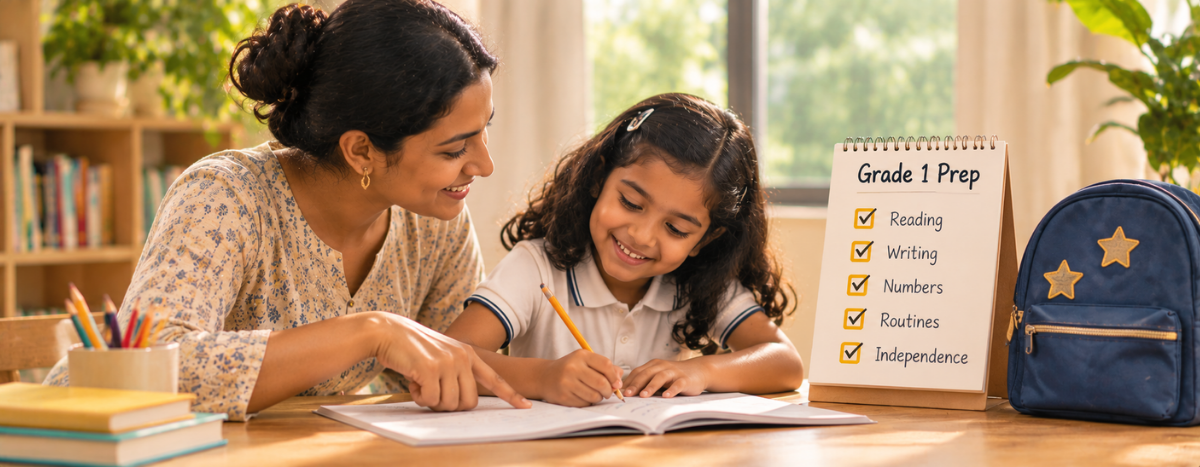
Use this checklist to reflect on the skills your child is beginning to develop. It is a guide for parents, not an entrance test or a list of compulsory skills every child must master before Grade 1.
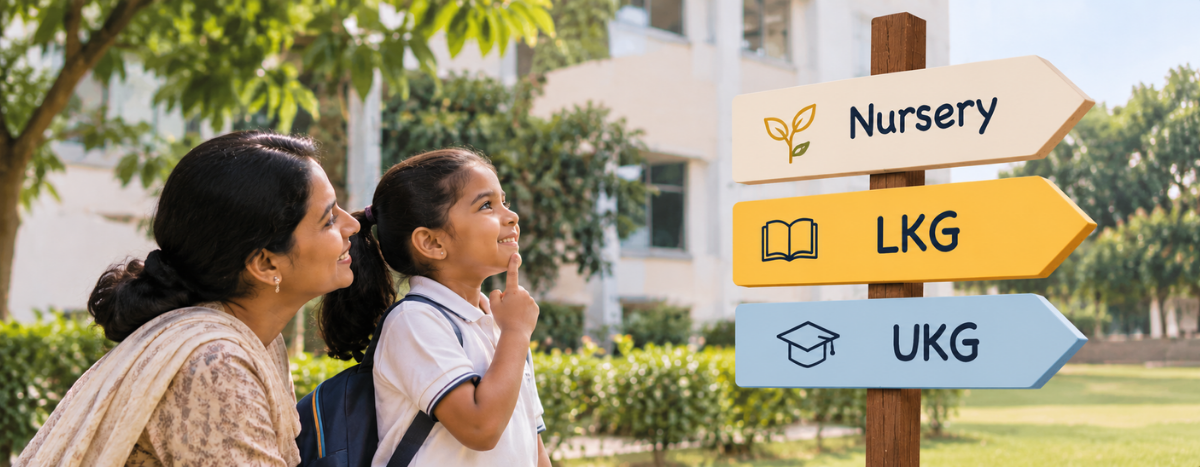
| Factor | Nursery | LKG / PP-1 | UKG / PP-2 |
|---|---|---|---|
| Typical age | Around 3 years | Around 4 years | Around 5 years |
| Main focus | Exploration and classroom familiarity | Foundational language and number concepts | Strengthening foundational skills and Grade 1 readiness |
| Language development | Listening, speaking, and vocabulary | Letter recognition, sounds, and communication | Early reading and writing readiness |
| Number concepts | Counting, colours, shapes and sorting | Number recognition and basic comparisons | Stronger number awareness and simple mathematical thinking |
| Social development | Sharing, interacting and participating | Cooperation, routines and independence | Confidence, responsibility and group participation |
| Learning approach | Play, stories, songs and exploration | Guided activities and hands-on learning | Structured activities alongside play-based learning |
| Next stage | LKG | UKG | Grade 1 |
Your child may be confident in some areas and still developing in others. That is expected. Use the checklist to identify where they could benefit from more practice, not to compare them with other children.
You don’t need special learning materials or a strict timetable to support school readiness. Many useful activities can be part of your regular day.
Choose an age-appropriate picture book and read it together. Ask your child to describe the characters, identify familiar objects, or tell you what they think might happen next.
Count steps while walking, fruits while shopping, or toys while putting them away. This helps children connect numbers with real objects.
Look for letters on signs, packaging and books. Start with letters in your child’s name and encourage them to notice familiar sounds.
Ask your child to group toys by colour, size or shape. You can also create simple patterns using blocks, buttons or household objects.
Let your child arrange their shoes, put away toys, carry their own water bottle or help set the table. These tasks encourage responsibility and independence.
Board games, building activities and pretend play help children practise waiting, listening, following simple rules and cooperating with others.
Set aside time for getting ready, eating breakfast, organising a bag and completing a simple activity. This helps your child become familiar with the rhythm of a school morning.
Keep these activities enjoyable. A few minutes of meaningful interaction each day is more helpful than turning every activity into a lesson.
Even a child who seems well prepared may need time to settle into a new school environment. The first few weeks are an opportunity to build familiarity and trust.
Here are a few ways to make the transition easier:
Most importantly, let your child talk about school without turning every conversation into a question-and-answer session. Listening can help you understand how they are experiencing the transition.
Parents naturally want their children to have a confident start. However, preparation can become stressful when expectations are too high.
Watch out for these common mistakes:
Expecting children to read and write fluently before admission: Early literacy skills develop over time. A child does not need to master the entire Grade 1 curriculum in advance.
Relying only on worksheets and tuition: Academic exercises cannot replace conversation, play, stories, physical activity, and social interaction.
Comparing children with classmates or siblings: Development varies. Comparisons can create unnecessary pressure and reduce a child’s confidence.
Ignoring emotional readiness: A child may recognise letters and numbers but still need support with separation, communication, or unfamiliar routines.
Making school sound frightening: Avoid using school, teachers, or homework as threats. Help your child develop a realistic and positive picture of school life.
Doing everything for the child: When parents complete every small task, children lose opportunities to practise independence. Allow them to try, even if it takes longer.
Preparation should smooth the transition, not make childhood feel like an extended examination.
The school you choose plays an important role in how your child experiences the move from early years education to primary school. Look beyond the admission process and understand how the school supports children’s learning and adjustment.
When evaluating a school, consider:
A campus visit can help you understand these aspects better. Observe the learning spaces, ask questions, and discuss your child’s needs with the admissions team.
At Tatva Global School, we encourage parents to understand the learning environment and ask questions before deciding on admission. We are a CBSE-affiliated school in Gajularamaram, Kukatpally, Hyderabad, with an 11-acre campus. Parents exploring Grade 1 admissions for 2027–28 can speak with our admissions team to understand the admission process and age eligibility.
Our educational philosophy is guided by Cognition, Curiosity, Compassion, and Character. These ideas reflect our belief that a child’s growth involves more than academic progress. It also includes how they think, explore, relate to others, and develop as individuals.
The best way to understand whether Tatva Global School is the right environment for your child is to experience the campus and have a conversation with our team.
Choosing the right school is an important decision. Visit Tatva Global School, explore our learning environment, and speak with our admissions team about Grade 1 admissions for 2027–28.
Focus on six areas: foundational language and maths, independence, social skills, emotional confidence, and daily routines. Read together, practise counting through everyday activities, encourage self-help skills, and help your child become comfortable with simple instructions and group activities.
A child can benefit from recognising some familiar letters and numbers, listening to stories, communicating basic needs, counting familiar objects, and following simple instructions. They should also have opportunities to practise independence and interact with other children. These are developmental starting points, not a compulsory academic checklist.
Establish a predictable routine, talk positively about school, encourage your child to share their experiences, and stay in touch with the teacher. Give them time to become familiar with their classroom, classmates, and new responsibilities.
Reading stories, counting household objects, sorting toys, recognising letters, playing board games, drawing, and practising small responsibilities are useful activities. Keep them enjoyable and include them naturally in everyday life.
Look at your child's overall development rather than one academic skill. Consider whether they are beginning to communicate their needs, engage with stories and simple number activities, interact with others, follow basic instructions, and attempt age-appropriate tasks independently. If you are unsure, speak with the child's current teacher and the prospective school's admissions team.
NEP 2020 and the National Curriculum Framework place Grade 1 within the Foundational Stage, which covers ages three to eight, and support a six-year entry age for Grade 1. However, parents should confirm the applicable admission-age requirements and cut-off date for the relevant academic year with the school and the appropriate state or board authorities. For Tatva Global School, the recommended age for Std. I is six years, in line with NEP 2020.
No. Children do not need to be fluent readers or writers before entering Class 1. Familiarity with letters, sounds, books, drawing, and early writing activities can provide a helpful foundation. Formal literacy skills continue to develop through classroom learning.
Talk about what a school day may involve, listen to your child's concerns, and reassure them that it is okay to ask for help. If possible, familiarise them with the school environment before the first day. Avoid making promises that every moment will be easy; instead, help them feel confident that they can manage new experiences with support.
Admissions for 2026–27 are open.
We’ll hold the door.